
Rewild At Heart
Why I moved to Scotland to get a Master's degree

That’s the big news I’ve been hinting at all year. I moved to Glasgow, Scotland to get a Master’s of Fine Art (MFA) degree at the Glasgow School of Art (GSA). I sold nearly everything I owned, crossed an ocean with 10 large pieces of luggage full of gear, found a flat after 60 viewings and 40 rejected(!!!) applications in July, and began the semester in September.
I’ve had more in person contact with human beings in this time period than I have in the last five years put together. The transition has been quite rough at times on my mental health, but I finally feel like I’m letting go of expectations, making the most of things, and adjusting. That’s why I’ve been on a bit of a hiatus. There’s so, so much going on that I want to tell you about from art experiments to the first flat show I staged last week to ongoing research, but I’ll start with why.
My admissions essay is below. I am sure it is way too earnest, especially for the UK, and I can sympathize. I am not personally comfortable with my levels of earnestness either. You have my condolences and middle fingers in equal measure.
I’ve seen my work printed the size of gallery walls, flickering across theater screens in museums, and used as a backdrop for a stadium tour, but I keep wondering, ‘This is incredible, so why does it feel like something is missing?’ immediately followed by guilt. Shouldn’t I be thrilled? The guilt does nothing to stop the persistent tapping on the back of my mind. It’s not a lack of gratitude; it’s a message trying to get through: something needs to change.


In 2019, I finished California on Fire, a cinematic video art time-lapse project for which I shot nearly half a million photographs. Instead of a human protagonist, the main character is the land. I trained as a wildland firefighter and bought used Nomex PPE gear, including the forest green pants, iconic yellow shirt, matching hard hat, boots with melt-proof vibram soles, gloves, goggles, and a fire shelter created with technology developed by NASA for shuttles re-entering the atmosphere. The project expanded to a 15,000-meter towering pyrocumulus cloud spanning more than a decade, during which I raced across the vast length of California chasing down nearly 100 wildfires. I saw tens of thousands of homes burned to the ground, buried people’s dead pets, and talked to countless Californians literally picking through the ashes of their lives. I saw broken hearts and quiet resilience in equal measure. The resulting film took a year to edit and is structured in five chapters based on the grieving process because everyone, including me, seemed to be chaotically bouncing between denial, anger, bargaining, sadness, and acceptance; the stages of grief in superposition.


It’s impossible to feel professionally ‘thrilled’ as 12,000 homes still smolder in Los Angeles at the time of writing and global carbon output continues increasing. In 2017 the Thomas Fire in Ventura was the largest fire in California state history at 281,893 acres (1140 sq km; 114,078 ha). In 2025 it is the ninth largest fire in state history, and is destined to drop out of the top ten. The two largest fires in state history now hover around one million acres (4047 sq km; 404,685 ha). At that size they’re referred to as gigafires.
Showing climate change as a visceral condition of the present is undeniable in this project, but when I revisit California on Fire questions fall through my mind. Where is the calm that comes from sitting under a pine tree? Where is the satisfying crunch of brown pine needles underfoot? Where is the wave of ecstasy when the first drop of rain hits the desert floor? Or the awe of the Milky Way glowing through western skies on a moonless night? I’ve got terror covered; where is love, connection, and joy?
In 2022, I created an installation consisting of three optical illusion paintings and a companion film, Transmutation House. It is an 86-second perfect loop that took 800 hours to complete. I ritualized the art-making process as a component of the creative act. Conceptually and personally, the intention of the artwork was to process the suicide deaths of two friends. The color palettes of the paintings are various combinations of our favorite colors. Despite tragic beginnings, it became a place where I wanted to spend time. In the off-hours, when people weren’t visiting the installation, I often found myself sitting quietly on the floor doing nothing. In hindsight, it seems like time spent taking shelter from the hurricane of capitalist productivity raging outside. In that monastic space I could simply be. Sad, at first. Then at peace. Quiet. Still. Happy, even.


James Turrell’s Skyspace installations have a similar effect on body and mind. It is impossible to enter one of these spaces without being changed. It’s artistic, monastic, and an abstract ritual. It’s art that speaks directly to your heart and gut by connecting you viscerally to the sky. My shorthand for this is, ‘art that does.’
The phrase real-time places our species at the center of the universe yet again, but with the when instead of the where. All time is real unless none of it is. Real-time would be better expressed as human-earth-time. My video art pieces are primarily composed of compressed time (time-lapse) and slow motion. They often induce temporary dyschronometria, a condition that makes it difficult to estimate the passage of time accurately, as a natural consequence of viewing a time scale that is not human-earth-time.
From a neurological point of view, each neuron in our bodies has a set of clocks that measure time scales from small to large (seconds, minutes, hours, days, etc.). The unfamiliarity of experiencing different clock speeds stretches the mind, inducing a state similar to The Overview Effect. Many people exit screenings of my films estimating their lengths with comical inaccuracy. Twenty-five-minute films are five. Three-minute films are ten. Even the curators get it wildly wrong after repeated viewings. This phenomenon needs no wall text to explain. It just happens. It’s art that does.
The Glasgow School of Art’s Master’s program naturally fits the conclusions I’ve reached independently about where I need to move and fleshes them out with interdisciplinary possibility, conceptual underpinnings, experimentation, and collaboration. I have more ideas than I know what to do with, but not all of them will work. What should stay, and what should go? How can I make them the best that they can be? Edward Steichen once said an artist should completely clear out their studio at least three times in life. This is one of those moments for me. It feels like starting over. I’m not skilled at it yet. That is what brings me here.
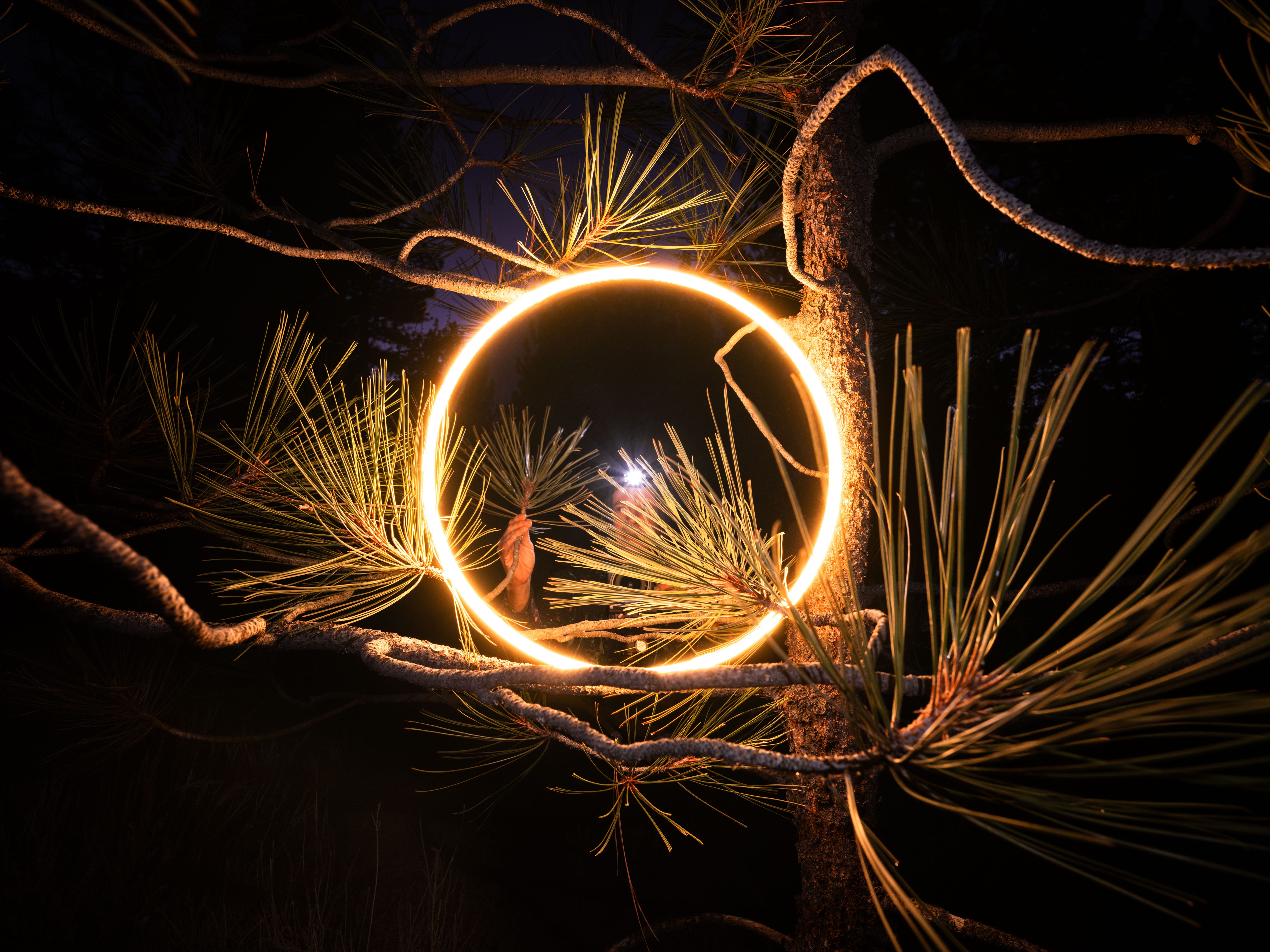
The persistent tapping at the back of my mind is trees talking. It’s mountains calling. It’s streams guiding me to rejoin steady cycles of nature through unhurried buildup and erosion. It’s anti-hustle culture. It’s drinking coffee first thing in the morning so I can read until noon. It’s leaning into the joy of creating work with my hands and protecting my peace. My work is being recalibrated towards rewilding my inner and outer world as a survival strategy through deep intuitive connections to nature, ritual, and play. My hope is that when it works for me, it will, in turn, resonate with others as they discover their own path back to the mysteries of the forest. What’s more antifascist than a human who is wild at heart?
—Jeff
PS - I’m raising funds to pay for this endeavor in three ways:
A long promised editioned print drop (details soon)
Creative Health Services (Instagram announcement)
Finally, a selection of large framed prints from touring museum shows, stored at Phillip K Smith III’s studio in Palm Desert, CA (price list & crated shipping available).
You’re a man that does, Jeff. You never cease to amaze. Sending wild vibes from Bombay Beach!